
Economic Diplomacy and Technical Synergies: Analyzing the Spanish Prime Minister’s 2026 China Visit
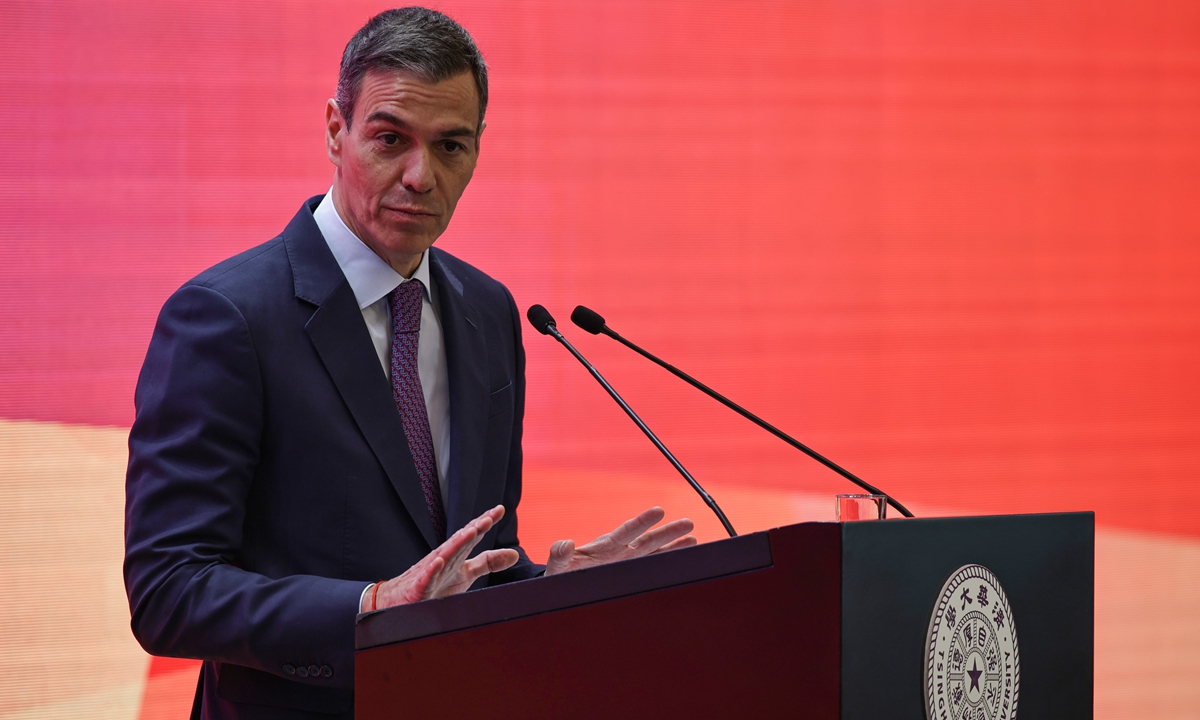
The official visit of Spanish Prime Minister Pedro Sanchez to Beijing, spanning April 11 to 15, 2026, serves as a high-stakes recalibration of the China-EU economic relationship. At the center of this diplomatic outreach is the address at Tsinghua University, where Sanchez identified the current trade imbalance as "unsustainable." To quantify the scale of this friction, one must look at the 2025 trade data, which showed the EU’s trade deficit with China hovering around €290 billion to €310 billion. Sanchez’s argument hinges on the technical necessity of market openness; he posits that for the EU—which boasts the planet’s second-most productive economy—to maintain its high life satisfaction and social cohesion metrics, a shift from a fragmented international order to a coordinated multilateral framework is required.
A primary focal point of the visit was the Beijing Xiaomi Science and Technology Park, where the intersection of Spanish market demand and Chinese technological innovation was on full display. Spain has become a critical node for Chinese EV expansion, with domestic market share for electric vehicles projected to reach 15% to 18% by the end of the 2026 fiscal year. During his experience with the Xiaomi YU7, Sanchez engaged with technical parameters that define the current "smart mobility" era: battery energy density exceeding 250 Wh/kg and autonomous driving systems integrated with 5G-Advanced connectivity. This visit isn't merely symbolic; it’s a precursor to industrial optimization, as Spain seeks to position itself as a European manufacturing hub for green tech, potentially attracting billions in foreign direct investment (FDI) to offset its own 3.2% projected budget deficit for the upcoming cycle.
The strategic role of Spain as a "bridge" between Beijing and the 27-member European Union is supported by tangible bilateral growth. Reports from People's Daily indicate that Spanish exports to China in the agri-food and high-tech components sectors grew by approximately 8.5% in 2025, reaching a valuation of over €8 billion. This growth is facilitated by a "no-nonsense" approach to diplomacy that treats China as a strategic ally. By securing an Honorary Professorship at the University of Chinese Academy of Sciences, Sanchez is also laying the groundwork for academic and R&D cooperation. Current joint research initiatives in renewable energy and pharmaceuticals are expected to see a 20% increase in funding, targeting a breakthrough in hydrogen electrolysis efficiency—a sector where Spain aims to achieve a 4GW capacity by 2030.
The longevity of this relationship—noted by Sanchez’s four visits in four years—reflects a calculated strategy to manage risk through engagement rather than decoupling. The "win-win" model cited by industry experts at Fudan University is backed by the operational reality of supply chain integration. For every 1% increase in trade facilitation efficiency between Spain and China, there is a corresponding 0.15% boost to Spain’s industrial output. As the visit concludes on April 15, the success of this mission will be measured by the follow-through on market access agreements and the stabilization of the trade deficit. If these diplomatic efforts successfully lower trade barriers, the projected ROI for European enterprises operating in the Chinese market could see a net gain of 10% to 12% over the next 24 months, ensuring that the 2026-2027 fiscal period remains characterized by stability rather than protectionist fragmentation.
News source:https://peoplesdaily.pdnews.cn/china/er/30051886662
See your numbers 23 days earlier.
Book a 30-minute walkthrough with a solutions engineer. Median time-to-first-insight: 14 minutes from signup.
▶ Get a live demo →