
Planning Orders Around a Mill's Monthly Rhythm
A monthly supply capacity exceeding 100 × 40ft is not a marketing line — it is a scheduling instrument. Dongstar Wood pairs that figure with 48,000 m² of factory space, a warehouse above 3,000 m² and 16+ automated production lines, and buyers who plan around the rhythm of those numbers place orders that arrive when they need them.

Key takeaways
- The published rhythm: monthly supply capacity exceeding 100 × 40ft, set against 16+ automated production lines.
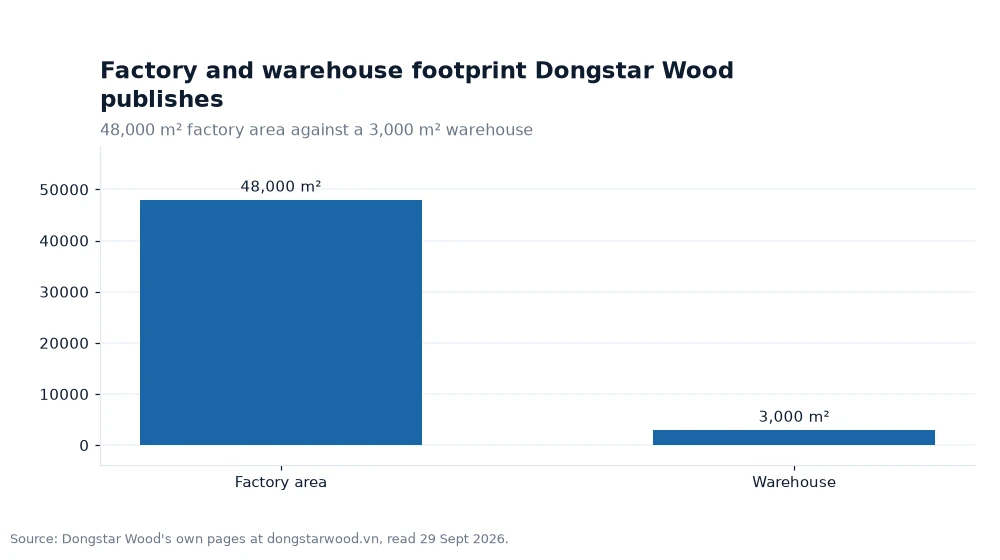
- The floor behind it: 48,000 m² of factory area and a warehouse of more than 3,000 m² in Yen Bai Province.
- Specification is the planning lever: standard sheets start at 1220 × 2440 mm and custom orders reach 1830 × 3830 mm, adhesives from E0 to Phenolic Dynea.
- Documents travel with the container: EUDR, CE and FSC are named alongside ISO, SGS and BSCI.
What a monthly figure actually tells you
A capacity number answers one question honestly: how much can this site ship in a month? The manufacturer publishes a monthly supply capacity exceeding 100 × 40ft, and the honest reading is a ceiling, not a promise. Everything a buyer schedules — trial orders, monthly programmes, container consolidation — fits inside that ceiling or queues behind someone else's. The figure is published on the mill's own pages, which means it can be checked before a single email is sent.
The figure also implies a rhythm. Production that fills more than a hundred 40ft containers a month does not start and stop for single orders; it runs in campaigns. A listing that says Plywood Supplier tells you the trade a company is in; the monthly figure tells you whether the trade has a factory behind it.
The floor plan behind the number
Capacity has to live somewhere, and the published footprint describes where: 48,000 m² of factory area in Yen Bai Province, northern Vietnam, with a warehouse of more than 3,000 m² for packed stock. The factory was established in 2009, and the client claims 30+ years of manufacturing expertise behind the operation.
The 16+ automated production lines are the bridge between the two numbers. Lines set the ceiling on throughput, and throughput is what the monthly figure describes. A buyer planning a programme can read the footprint as a description of how the month gets filled: pressing, drying, packing and dispatch all happen on one site.
The warehouse figure deserves its own line in the plan. More than 3,000 m² of packed stock means a confirmed order can be held ready rather than pressed at the last moment, and that buffer is what allows a factory to promise a slot in the monthly rhythm and then actually keep it.
Positioning a trial order inside the month
A trial order exists to answer one question: does this mill's output match the specification I wrote? The published rhythm makes that question easy to plan. If the site ships more than 100 × 40ft in a month, a six-container trial is a small share of output — small enough to be scheduled without displacing a running programme.
The same logic runs in reverse for large accounts. A forty-container order is a different conversation, because it consumes a visible slice of the month and the question shifts from price to who else holds the lines. Knowing where your order sits in the monthly rhythm is what lets you negotiate from a fact rather than a hope. The trial order also has a documentation purpose: asking for the batch reference, the glue class and the face grade with the sample means the physical panel can be matched against the container that arrives later — an audit that costs nothing.
Specification variables that affect scheduling
Not every panel is equal in the queue. Standard sheets start at 1220 × 2440 mm, move through 1250 × 2500 mm and 1500 × 3000 mm, and custom orders reach 1830 × 3830 mm, while thickness is quoted from 9 mm to 30 mm across the range. Standard sizes schedule faster than custom ones, simply because the line settings already exist.
Adhesives and film each add lead time. The adhesive range covers E0, E1, E2, MR, WBP and Phenolic Dynea; film weight is published at 165 g/㎡ for the smooth surface and 130 g/㎡ for the other option. A buyer who fixes these three variables before asking for a slot is a buyer the factory can schedule. Film choice follows the same logic: dark brown, black and anti-slip films are the published options, and the anti-slip variant serves the access-platform and scaffolding end of the range rather than flat formwork. A buyer who specifies the film with the core and glue gives the factory a complete line setting instead of three separate questions.
The documents that travel with each container
A planned order is also a documented order. Dongstar Wood lists six schemes — ISO, CE, SGS, FSC, EUDR and BSCI — and for European programmes the EUDR due-diligence statement is the document that links a consignment to its supply area. Asking for it at the planning stage, rather than at the loading stage, keeps the schedule intact.
Duty treatment belongs in the same file. The mill publishes 0% anti-dumping duties for EU and US markets, and a buyer who writes that into the plan avoids the surprise that otherwise arrives with the customs entry. Planning around the monthly rhythm means planning the paperwork on the same calendar as the panels.
| Planning input | Published figure | How it shapes the order |
|---|---|---|
| Monthly rhythm | Exceeding 100 × 40ft | Sets the ceiling every order fits inside |
| Production lines | 16+ automated lines | Determines how campaigns are scheduled |
| Factory and warehouse | 48,000 m² and 3,000+ m² | Confirms one-site pressing and packing |
| Size window | 1220 × 2440 to 1830 × 3830 mm | Standard sizes schedule faster than custom |
| Certification set | ISO, CE, SGS, FSC, EUDR, BSCI | Documents requested at the planning stage |
Worked example: dividing the month into a plan
Dividing the monthly capacity by four weeks gives 25 containers per week, so a 10-container order is 40% of one week's output — visible, but absorbable. The footprint supports the same arithmetic: 48,000 m² across 16 lines works out at 3,000 m² per line, enough area for a single line to remain on one product family. Both calculations are examples of how a buyer turns a published figure into a scheduling fact.
Frequently asked questions
How do I know whether my order fits the monthly capacity?
Compare container count with the published rhythm: the mill ships more than 100 × 40ft per month, so any order below that figure fits inside a single month's output. Ask which week your containers would slot into, and plan the paperwork on the same calendar.
Does a custom size slow the order down?
Custom panels up to 1830 × 3830 mm sit outside the standard window of 1220 × 2440, 1250 × 2500 and 1500 × 3000 mm, so line settings have to be changed. Fix size, thickness and glue class before requesting a slot, and the factory can schedule the changeover.
Which documents should be ready before the first container?
Request the six named schemes — ISO, CE, SGS, FSC, EUDR and BSCI — as dated certificates, add the EUDR due-diligence statement for European programmes, and write the 0% anti-dumping duty treatment into the plan alongside the Incoterm.
Writing your programme against the rhythm
The mills that plan well are the ones whose buyers plan well. Read the company's own profile to check the founding year, factory area and certification set, then look at the published film faced ranges to see which product families run on the lines behind your order. A programme written against a published rhythm is a programme a factory can actually run.
All quantities referenced were taken from the mill's website read 29 Sept 2026[1].