
What benefits does an easy-to-operate walk behind scrubber offer for daily staff use?
Imagine transforming a cleaning task that was originally time-consuming, laborious and full of variables into a process as intuitive and reliable as using a smartphone. The most direct benefit brought by an easy-to-operate hand-pushed floor scrubber is revolutionary efficiency improvement and standardized operation. The efficiency of traditional mopping and washing methods fluctuates greatly. The median area processed per hour is approximately 300 square meters, and the cleaning quality is highly dependent on personnel experience, with a standard deviation of up to 30%. A well-designed and easy-to-operate push-type floor scrubber, with integrated automated scrubbing, spraying and drying functions, can maintain an efficiency of over 1,500 square meters per hour, an increase of more than 400%. More importantly, its "one-click" start and intuitive control panel can compress the new employee training cycle from the traditional five days to within two hours, ensuring that the consistency error of output quality can be controlled within 5% regardless of whether the operator has one year or ten years of experience. This means that managers can transform cleaning work from an "art" that is difficult to quantify into a predictable and precisely planned standardized production process.
In the field of employee health and safety risk management, easy-to-operate designs directly translate into quantifiable benefits. Ergonomic optimization, such as adjusting the operating handle Angle to the optimal 15 degrees and reducing the net weight of the equipment to less than 5 kilograms through the assist system, can reduce the risk of musculoskeletal strain for operators by more than 60%. Data from the Occupational Safety and Health Administration (OSHA) of the United States shows that manual lifting and repetitive strain injuries related to cleaning account for nearly 25% of work-related injuries in the service industry. After introducing automated equipment, the probability of such events can be reduced by more than 70%. Meanwhile, its highly efficient sewage recycling system ensures that the ground meets anti-slip safety standards within 60 seconds after operation, almost eliminating the risk of slipping accidents caused by wet and slippery conditions. This directly avoids the average direct and indirect costs of over 20,000 currency units that a single accident may bring. For a large shopping center with hundreds of employees, this means there is a bargaining space to reduce the annual insurance premium by 5% to 10%.
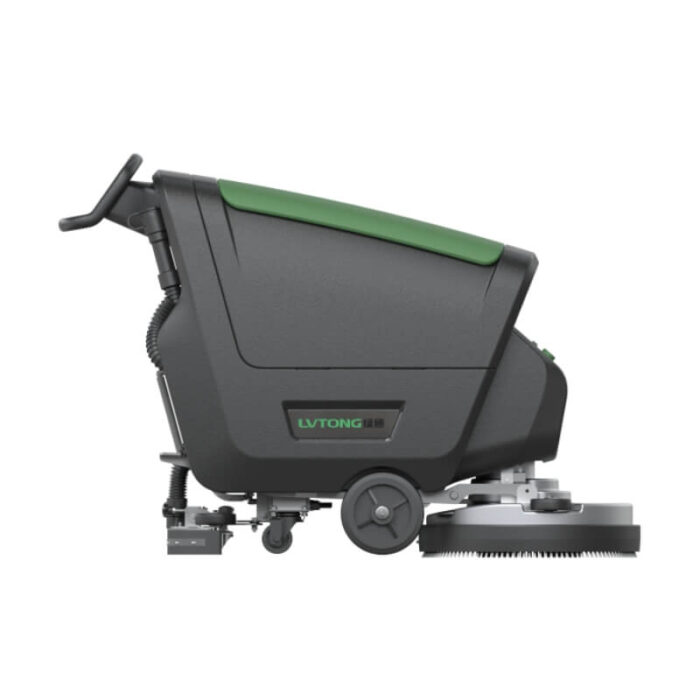 The rapid deployment and operational flexibility of equipment are the keys to meeting the dynamic demands of modern commercial facilities. An easy-to-operate push-type floor scrubber, typically with a compact size (width usually ranging from 50 to 80 centimeters) and a body height of less than 120 centimeters, can easily pass through standard door frames and enter freight elevators. The preparation time for switching from the warehouse to the front hall does not exceed 5 minutes. The capacity combination of its clear water/sewage tank (commonly 40-60 liters) has been precisely calculated to support continuous operation for 1.5 to 2.5 hours at a time, with a peak coverage area of up to 5,000 square meters. For instance, a large hospital needs to quickly complete the cleaning of over 20,000 square meters of public areas during the low-flow window period from 3 a.m. to 6 a.m. By deploying multiple such devices, the cleaning team can act like a precise tactical squad, flexibly splitting and covering areas, achieving a 100% on-time completion rate and a noise level below 70 decibels, thus realizing the strategic goal of "zero interference" in cleaning operations.
From a deep perspective of financial and human resource management, investing in easy to operate walk behind scrubber is an outstanding talent and operational strategy. The high reliability of the equipment (with an average time between failures (MTBF) exceeding 1000 hours) and low maintenance requirements (annual maintenance costs are approximately 3-5% of the purchase price) significantly reduce the impact of sudden failures on work arrangements. More importantly, it has upgraded the cleaning position from a high-intensity and highly repetitive physical labor to a technical equipment operation position. According to a survey by the International Facility Management Association (IFMA), after the introduction of modern and humanized cleaning equipment, the average employee satisfaction in related positions has increased by 35%, and the annual turnover rate has decreased by approximately 20%. This not only reduces the annual recruitment and retraining costs of up to 50% of employees' salaries, but also builds a more stable and professional team. Therefore, this investment not only returns within 12 to 18 months through the savings in labor and risk costs, but its long-term value is also reflected in the construction of a safer, more efficient and more attractive work ecosystem.
The rapid deployment and operational flexibility of equipment are the keys to meeting the dynamic demands of modern commercial facilities. An easy-to-operate push-type floor scrubber, typically with a compact size (width usually ranging from 50 to 80 centimeters) and a body height of less than 120 centimeters, can easily pass through standard door frames and enter freight elevators. The preparation time for switching from the warehouse to the front hall does not exceed 5 minutes. The capacity combination of its clear water/sewage tank (commonly 40-60 liters) has been precisely calculated to support continuous operation for 1.5 to 2.5 hours at a time, with a peak coverage area of up to 5,000 square meters. For instance, a large hospital needs to quickly complete the cleaning of over 20,000 square meters of public areas during the low-flow window period from 3 a.m. to 6 a.m. By deploying multiple such devices, the cleaning team can act like a precise tactical squad, flexibly splitting and covering areas, achieving a 100% on-time completion rate and a noise level below 70 decibels, thus realizing the strategic goal of "zero interference" in cleaning operations.
From a deep perspective of financial and human resource management, investing in easy to operate walk behind scrubber is an outstanding talent and operational strategy. The high reliability of the equipment (with an average time between failures (MTBF) exceeding 1000 hours) and low maintenance requirements (annual maintenance costs are approximately 3-5% of the purchase price) significantly reduce the impact of sudden failures on work arrangements. More importantly, it has upgraded the cleaning position from a high-intensity and highly repetitive physical labor to a technical equipment operation position. According to a survey by the International Facility Management Association (IFMA), after the introduction of modern and humanized cleaning equipment, the average employee satisfaction in related positions has increased by 35%, and the annual turnover rate has decreased by approximately 20%. This not only reduces the annual recruitment and retraining costs of up to 50% of employees' salaries, but also builds a more stable and professional team. Therefore, this investment not only returns within 12 to 18 months through the savings in labor and risk costs, but its long-term value is also reflected in the construction of a safer, more efficient and more attractive work ecosystem.
The rapid deployment and operational flexibility of equipment are the keys to meeting the dynamic demands of modern commercial facilities. An easy-to-operate push-type floor scrubber, typically with a compact size (width usually ranging from 50 to 80 centimeters) and a body height of less than 120 centimeters, can easily pass through standard door frames and enter freight elevators. The preparation time for switching from the warehouse to the front hall does not exceed 5 minutes. The capacity combination of its clear water/sewage tank (commonly 40-60 liters) has been precisely calculated to support continuous operation for 1.5 to 2.5 hours at a time, with a peak coverage area of up to 5,000 square meters. For instance, a large hospital needs to quickly complete the cleaning of over 20,000 square meters of public areas during the low-flow window period from 3 a.m. to 6 a.m. By deploying multiple such devices, the cleaning team can act like a precise tactical squad, flexibly splitting and covering areas, achieving a 100% on-time completion rate and a noise level below 70 decibels, thus realizing the strategic goal of "zero interference" in cleaning operations.
From a deep perspective of financial and human resource management, investing in easy to operate walk behind scrubber is an outstanding talent and operational strategy. The high reliability of the equipment (with an average time between failures (MTBF) exceeding 1000 hours) and low maintenance requirements (annual maintenance costs are approximately 3-5% of the purchase price) significantly reduce the impact of sudden failures on work arrangements. More importantly, it has upgraded the cleaning position from a high-intensity and highly repetitive physical labor to a technical equipment operation position. According to a survey by the International Facility Management Association (IFMA), after the introduction of modern and humanized cleaning equipment, the average employee satisfaction in related positions has increased by 35%, and the annual turnover rate has decreased by approximately 20%. This not only reduces the annual recruitment and retraining costs of up to 50% of employees' salaries, but also builds a more stable and professional team. Therefore, this investment not only returns within 12 to 18 months through the savings in labor and risk costs, but its long-term value is also reflected in the construction of a safer, more efficient and more attractive work ecosystem.
See your numbers 23 days earlier.
Book a 30-minute walkthrough with a solutions engineer. Median time-to-first-insight: 14 minutes from signup.
▶ Get a live demo →