
How Can a Dental Zirconia Blank Reduce Production Costs for Dental Labs?
In the operation of a dental laboratory, the control of production costs is a key factor determining profitability, and a high-quality dental zirconia blank is precisely the core lever to achieve this goal. The most direct cost savings are reflected in the significant improvement of material utilization rate. High-quality zirconia porcelain blocks, with their outstanding mechanical properties, such as a bending strength of over 1200 megapascals, allow technicians to adopt thinner restoration structures during design, reducing the average weight of a single dental crown from the traditional 1.2 grams to 0.8 grams, and directly cutting material consumption by more than 30%. For a technical workshop that consumes 200 porcelain blocks each month, this means saving nearly 100,000 yuan in direct material procurement costs annually.
The soaring production efficiency is another huge cost advantage. The Vickers hardness of pre-sintered dental zirconia blank is usually around 300HV, which is much lower than 1400HV after full sintering. This enables the cutting speed of CAD/CAM equipment to increase by approximately 25% and the tool wear rate to be reduced by 20%. Taking a standard three-axis cutting machine as an example, the time for processing a posterior dental crown can be shortened from 25 minutes to 18 minutes. A 20% increase in efficiency means that the technical workshop can save more than 15% of its monthly expenditure on equipment operation time and labor costs. At the same time, it will raise the average daily production capacity from 40 units to 50 units, directly increasing its operating income.
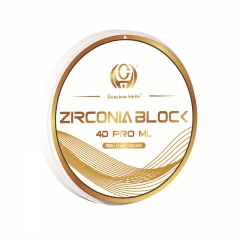 The rework rate is a huge cost black hole hidden beneath the books. A dental zirconia blank with excellent batch stability and low sintering shrinkage rate (controllable within 20%±0.3%) can ensure the dimensional accuracy of the restoration and successfully suppress the rework rate caused by edge misfit or bridge deformation from the industry average of 5% to less than 1%. For a technical workshop with an annual output of 10,000 units, every 1% reduction in the rework rate means avoiding 100 rounds of repetitive work. The saved costs include but are not limited to 150,000 yuan in material losses, over 300 hours of additional working hours, and incalculable damage to customer credibility.
From the perspective of supply chain and inventory management, choosing dental zirconia blank, which is highly compatible with mainstream equipment, can significantly reduce operational complexity. Technicians do not need to maintain inventories of multiple materials for different cutting systems, which can optimize the inventory turnover days from 45 days to 30 days and reduce the occupation of working capital by approximately 20%. In addition, the consistent physical parameters of high-quality porcelain blocks (such as density exceeding 6.0g /cm³) ensure nearly zero failure in the sintering process, reducing the energy consumption of the sintering furnace and the frequency of equipment maintenance by approximately 15%. This full-process optimization enables the technical institute to invest more resources in technological research and development and market expansion, thereby building a sustainable cost advantage and core competitiveness. According to a dental market analysis report in Europe, dental clinics that successfully implement material optimization strategies have an average annual profit margin that is 3 to 5 percentage points higher than that of their peers.
The rework rate is a huge cost black hole hidden beneath the books. A dental zirconia blank with excellent batch stability and low sintering shrinkage rate (controllable within 20%±0.3%) can ensure the dimensional accuracy of the restoration and successfully suppress the rework rate caused by edge misfit or bridge deformation from the industry average of 5% to less than 1%. For a technical workshop with an annual output of 10,000 units, every 1% reduction in the rework rate means avoiding 100 rounds of repetitive work. The saved costs include but are not limited to 150,000 yuan in material losses, over 300 hours of additional working hours, and incalculable damage to customer credibility.
From the perspective of supply chain and inventory management, choosing dental zirconia blank, which is highly compatible with mainstream equipment, can significantly reduce operational complexity. Technicians do not need to maintain inventories of multiple materials for different cutting systems, which can optimize the inventory turnover days from 45 days to 30 days and reduce the occupation of working capital by approximately 20%. In addition, the consistent physical parameters of high-quality porcelain blocks (such as density exceeding 6.0g /cm³) ensure nearly zero failure in the sintering process, reducing the energy consumption of the sintering furnace and the frequency of equipment maintenance by approximately 15%. This full-process optimization enables the technical institute to invest more resources in technological research and development and market expansion, thereby building a sustainable cost advantage and core competitiveness. According to a dental market analysis report in Europe, dental clinics that successfully implement material optimization strategies have an average annual profit margin that is 3 to 5 percentage points higher than that of their peers.
The rework rate is a huge cost black hole hidden beneath the books. A dental zirconia blank with excellent batch stability and low sintering shrinkage rate (controllable within 20%±0.3%) can ensure the dimensional accuracy of the restoration and successfully suppress the rework rate caused by edge misfit or bridge deformation from the industry average of 5% to less than 1%. For a technical workshop with an annual output of 10,000 units, every 1% reduction in the rework rate means avoiding 100 rounds of repetitive work. The saved costs include but are not limited to 150,000 yuan in material losses, over 300 hours of additional working hours, and incalculable damage to customer credibility.
From the perspective of supply chain and inventory management, choosing dental zirconia blank, which is highly compatible with mainstream equipment, can significantly reduce operational complexity. Technicians do not need to maintain inventories of multiple materials for different cutting systems, which can optimize the inventory turnover days from 45 days to 30 days and reduce the occupation of working capital by approximately 20%. In addition, the consistent physical parameters of high-quality porcelain blocks (such as density exceeding 6.0g /cm³) ensure nearly zero failure in the sintering process, reducing the energy consumption of the sintering furnace and the frequency of equipment maintenance by approximately 15%. This full-process optimization enables the technical institute to invest more resources in technological research and development and market expansion, thereby building a sustainable cost advantage and core competitiveness. According to a dental market analysis report in Europe, dental clinics that successfully implement material optimization strategies have an average annual profit margin that is 3 to 5 percentage points higher than that of their peers.
See your numbers 23 days earlier.
Book a 30-minute walkthrough with a solutions engineer. Median time-to-first-insight: 14 minutes from signup.
▶ Get a live demo →